
The Windshield Job Was Never Just Glass
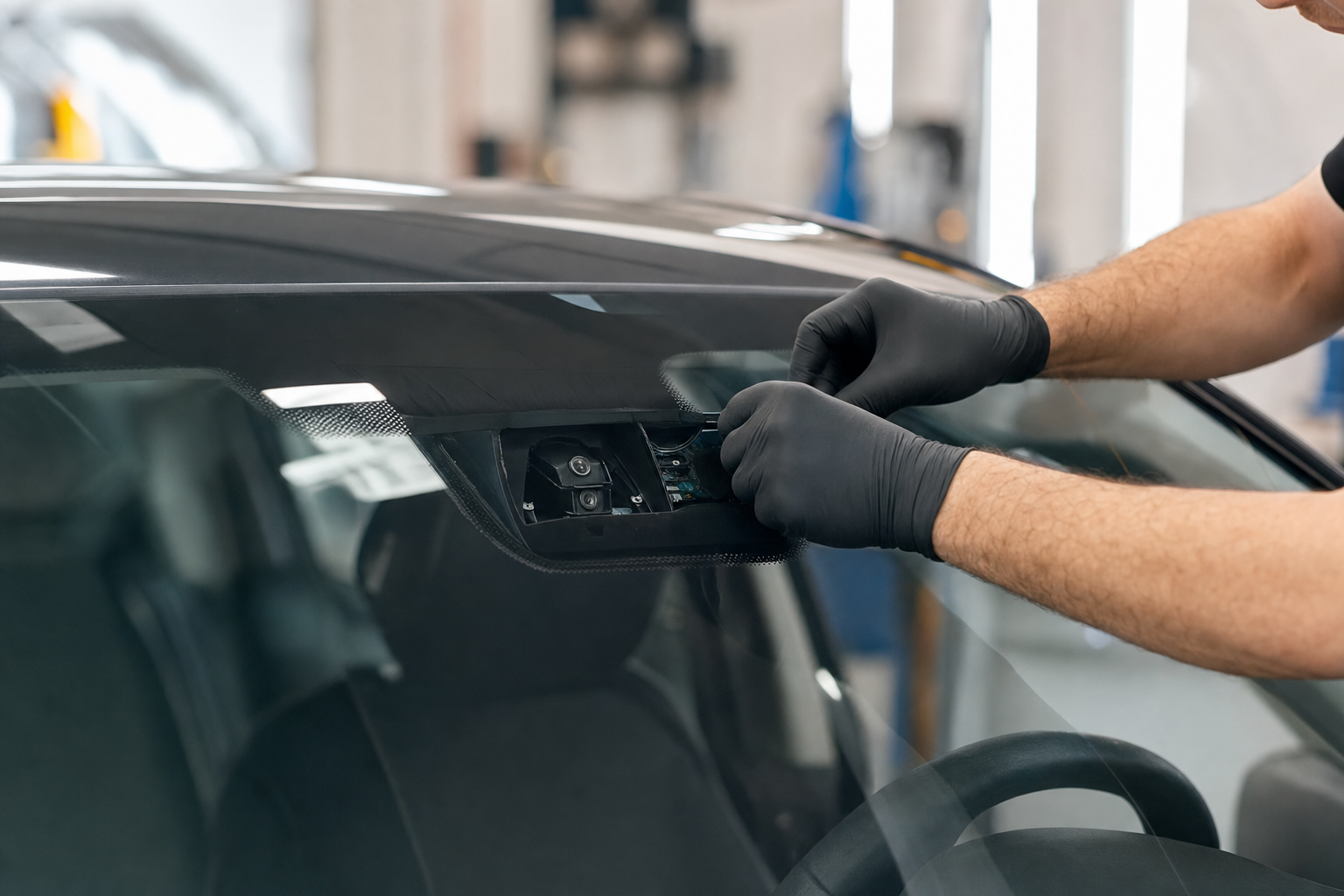
A customer drops off a car with a cracked windshield at nine in the morning and picks it up at four expecting a bill that matches the number they were quoted on the phone. Instead there's a new line item: camera recalibration, $400. No one mentioned it when they booked. The tech didn't bring it up until the car was already up on the lift and the camera housing came off with the old glass. Now the shop is having the same awkward conversation it has three or four times a week, and the customer is doing quiet math on whether this place tried to pad the bill.
That conversation isn't a training problem. It's a structural one. The person who answers the phone can't see the car, doesn't know its exact trim, and has no reliable way to know whether this specific vehicle has a forward-facing camera behind the mirror until someone physically looks at it. So most shops either guess low and eat the cost, or skip mentioning it and take the hit to trust at drop-off. Both outcomes cost the shop money. Only one of them also costs it a five-star review.
The Auto Glass Shops, VIN-Based ADAS Calibration Quote Tool is built to close that exact gap: a customer enters their VIN or photographs it, the tool decodes the exact vehicle and checks whether it needs recalibration, and it quotes the honest number before the car ever reaches the shop.
The small camera behind the mirror that changes the whole bill
Since roughly 2018, a growing share of new vehicles ship with a small camera mounted directly behind the rearview mirror. It watches lane markings and the car ahead to run lane-keep assist and automatic emergency braking. Pull the windshield out to replace it and that camera comes off, then goes back on in a position that's almost certainly off by a small amount, enough to matter for a system reading distance and lane position at highway speed. Recalibrating it means either a static procedure (target boards set up at precise distances in the bay), a dynamic procedure (a supervised test drive at specific speeds with a scan tool connected), or both together for vehicles that require dual calibration.
National pricing data for 2026 puts a plain glass-only replacement at $300 to $500 for a mainstream sedan with no camera system. Add a 2018-or-newer vehicle with ADAS and the number jumps to $450 to $900 once calibration is factored in, with the calibration step alone running $150 to $600 depending on which method the vehicle requires. That's not a rounding error on top of a glass job. It's very often the majority of the bill, and it's the exact part most likely to get discovered by the customer at the worst possible moment: after the old glass is already gone.
Why this is a genuinely different problem than a damage photo
Most instant-quote tools built for home-service trades work by pointing a camera at damage and asking an AI model to assess severity: a cracked pipe, a stained ceiling, a dented bumper. That approach doesn't map cleanly onto this problem, because the thing that determines the price here isn't damage severity at all. A hairline crack and a windshield that's completely shattered cost the same to replace. What actually determines the price is a fact about the vehicle itself, present or absent regardless of how bad the crack looks: does this specific car have a camera behind the mirror, and if so, which calibration method does it need.
That's a lookup problem, not a vision-assessment problem, and it's solvable with a much more reliable data source than an AI guessing from a photo of damaged glass. Every vehicle has a 17-character VIN, and the US government's own NHTSA vPIC database will decode any VIN into an exact year, make, model, and trim for free, no account or API key required. Once the tool knows exactly which car it's dealing with, cross-referencing that against a table of which vehicles carry a forward camera and which calibration method they need is a matter of accurate reference data, not machine vision. It's a fundamentally more precise mechanism for a problem where precision is exactly what's been missing.
That's also why the VIN-based calibration quote tool still asks two simple visual confirmation questions when a vehicle isn't a confident match in its lookup table: is there a small black housing behind the mirror, and is there a lane-keep or forward-collision light on the dash. A VIN decode alone tells you the trim level Toyota shipped from the factory. It doesn't catch every dealer-installed aftermarket package or the handful of rare regional trims a national lookup table won't have seen yet, so the visual check is there as a fallback rather than a primary method, catching the edge cases the database can't.
A worked example
Picture a customer whose 2021 compact SUV takes a rock chip on the highway that spreads into a crack overnight. They pull up the shop's booking tool on their phone, take a photo of the VIN plate visible through their own windshield, and the tool reads it, decodes it, and shows them: 2021, their exact make and model, their exact trim. One tap to confirm it's right. The tool already has this model in its calibration lookup table, knows it ships with a forward camera requiring dynamic calibration, and quotes them $500 to $750 for glass plus dynamic calibration, with one plain-language sentence explaining why: this car's lane-keep camera has to be recalibrated with a supervised test drive any time the windshield comes out. They book a slot for Thursday. The shop's phone buzzes immediately with the decoded vehicle and calibration type attached, so whoever's scheduling the bay already knows Thursday afternoon needs road-test time blocked out, not just a glass slot.
Now picture a second customer with a 2014 sedan, same crack, same highway rock chip. The VIN decodes fine, but that model year predates forward-camera ADAS entirely on this trim. The tool flags no camera, quotes a plain $300 to $500 glass-only job, and that customer never sees a calibration line item at all, because there genuinely isn't one. No awkward conversation either way, because the number they saw on their phone before booking is the number on the invoice when they pick the car up.
Where a shop that resells this makes the real money
This is the sharpest fit for an independent or small-chain auto glass shop already doing 15 or more replacement jobs a month, particularly one competing against national chains that already have slicker online quote experiences. The tell that a shop needs this is almost always some version of the same sentence: half our customers don't know their car needs calibration until we tell them at drop-off. That sentence means the shop is already doing these jobs. It just isn't pricing or scheduling them with any advance knowledge, which means every single one of them currently carries either a trust cost or a margin cost.
The blueprint prices a one-time setup between $2,500 and $4,000, and a monthly retainer of $297 to $497 covering hosting, SMS delivery, and the ongoing work of tuning the vehicle lookup table to match a given shop's real customer mix. That retainer math holds up easily against the value on the other side: a single calibration job the tool correctly identifies and books, instead of losing to a competitor who answered the phone with a faster, clearer number, is worth $450 to $900 on its own. The blueprint also includes an optional performance bonus, an extra $50 to $100 a month for every ten booked jobs sourced through the tool past an agreed baseline, since a handful of correctly-quoted calibration jobs can cover the entire retainer by itself.
The part that takes real work: teaching it the shop's actual cars
The honest caveat here, and the one worth being upfront with a client about before the first invoice goes out, is that the vehicle lookup table needs real calibration of its own in month one. It ships pre-seeded with roughly 40 of the most common ADAS-equipped models across Toyota, Honda, Subaru, GM, and Ford going back to 2018, which covers a real majority of what rolls through a typical American shop's bay. But every shop's actual customer mix is a little different, and the first few weeks will surface two or three vehicles the tool got wrong, either a camera it didn't know about or a calibration type it guessed incorrectly. That's not a bug to apologize for. It's the expected shape of rolling this out, and the blueprint's build process treats it as exactly that: a supervised two-week pilot where the shop keeps its old manual process running in parallel, every mismatch gets logged, and the lookup table gets corrected from real jobs before the shop trusts it to run unsupervised.
Where a reseller gets this wrong
The single most common way to undersell this blueprint is skipping that pilot step because the client is eager to go live immediately. A shop owner who's excited about the demo will often want to point every incoming call at the new tool on day one. Resist that. A wrong quote in week one, before the lookup table has ever seen this shop's actual vehicle mix, does more damage to trust in the tool than a slower, supervised rollout ever would. The two-week parallel-run period, comparing what the tool quoted against what the tech actually found at drop-off for every single job, is what turns a plausible-sounding table of national data into something that's actually accurate for this specific shop's customers.
The second mistake is quoting the client using the blueprint's default national price ranges instead of the shop's own real numbers. Auto glass and calibration pricing varies meaningfully by region and by each shop's own labor rate, and a shop whose real dynamic-calibration job runs $650 will lose trust fast the first time the tool quotes $500 to $750 and the actual invoice comes in above that range. Get the client's real pricing for all four tiers before the first line of the prompt gets filled in, not after the first confused customer calls back.
A third risk worth planning for: the lookup table is only ever as current as the last time someone updated it, and vehicle manufacturers add ADAS to new trims every model year without announcing it loudly. Build a habit into the retainer relationship, not just a one-time setup, where the shop's own front-desk staff add a row to the lookup table the moment they encounter a car the tool got wrong, using the simple admin screen built into the dashboard for exactly this. A tool that's accurate at launch and slowly drifts out of date over eighteen months as new models hit the road delivers a fraction of the value of one that keeps pace, and the difference between the two comes down entirely to whether that habit gets built in from day one or left as an afterthought.
Set the client's expectations on this explicitly during the sales conversation itself, not after they've signed. The full build brief includes the exact cold-outreach script for that first conversation, along with every build step needed to get from a blank Lovable project to a working, branded tool a shop owner can start using the same week.
Why this is worth building now
ADAS-equipped vehicles aren't a growing edge case anymore, they're rapidly becoming the majority of what rolls onto any glass shop's lift, and that share only grows every model year. The shops treating calibration as an awkward surprise conversation are competing against a small but growing number of chains that already quote it upfront online, and every year that gap widens is a year of lost trust and lost margin for the shops still doing it the old way. A tool built specifically around what actually determines the price, the vehicle's own known configuration rather than a photo of damage that tells you nothing about the camera behind the glass, is the kind of blueprint that's immediately useful on day one instead of merely impressive in a sales demo.
Every business this ships to also becomes a real app, not just a bookmarked link. The blueprint's final build step wraps the finished tool through AppBuild.DIY, turning it into a native iOS and Android app with push notifications, so the shop's staff get an instant phone alert for a new booked job instead of relying on checking a dashboard, and customers get the trust signal of a real App Store listing with the shop's own name and icon instead of just another web form.
If you're already reselling white-label apps or looking for the next vertical with real, groundable economics behind it, the full build steps, the exact master prompt, and a ready cold-outreach script are all in the Auto Glass VIN-Based ADAS Calibration Quote Tool blueprint, ready to fill in with a real shop's numbers and ship this week.